Japanese VR Game Designed to Enhance Vision
Author: Eleanor
Jan 21,2026


Between smartphones, game consoles, and computers, it’s all too easy to accumulate excessive screen time nowadays. As anyone who has endured eye strain after a long gaming session or a bout of doomscrolling knows, this is far from ideal for your eye health. Constantly focusing on screens fatigues the ciliary muscles in your eyes, which are responsible for adjusting focus, and can contribute to the development of nearsightedness. But what if the solution to better vision involved… even more gaming?
A recent study from researchers at Japan’s Kwansei Gakuin University developed a VR game designed to enhance players’ eyesight. While further investigation is required, this game shows potential as a tool to help individuals with basic myopia, or nearsightedness, strengthen their vision.
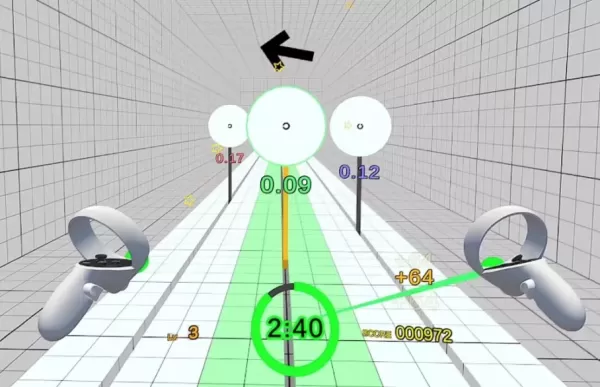
The game itself is a relatively straightforward target-shooting experience built in Unity for the Meta Quest 2. It features three lanes, each with a circular target on a post. Pressing the controller’s trigger activates a virtual laser beam. Aiming this laser at a lane highlights it and the target, putting the player into "aim" mode. To successfully score a hit, however, players must move the controller's stick in the direction indicated by a small Landolt C—a black ring with a gap, commonly used in Japanese eye exams—positioned in the target's center.
This VR game was created to exercise the eye muscles. Players must continually shift their gaze between targets at various distances and then refocus on the Landolt C to identify the gap's location. Upon finishing a round, players are presented with an arcade-style results screen displaying their hits, misses, combos, and whether they set a new record (some participants reportedly became quite competitive about achieving high scores).
The study's outcomes revealed that the game effectively improved the vision of all participants over the six-week trial. Notably, for those with severe myopia, more frequent gameplay correlated with greater vision improvement.
It's important to note that this was a small-scale study involving only ten young participants aged 22 to 36. More comprehensive research is necessary to determine if such a VR game could become a viable future treatment for nearsightedness. According to the cited Japanese research paper, the team intends to conduct further experiments with the VR game to confirm its effectiveness.





![A Father’s Sins – Going to Hell [Ch. 7 Public] By Pixieblink](https://imgs.39man.com/uploads/67/1719578270667eae9eb6a75.jpg)